

Wyoming

Wyoming

Yellowstone is home to the largest free-ranging bison population in the U.S., offering a rare glimpse into their natural behavior in the wild.
They live in majestic matriarchal family herds where the experienced older cows provide protection, social structure, and learning opportunities for younger bison while the bulls often live alone or in bachelor groups, joining the family herds during the summer mating season.
Wild bison in the US once ran into the millions but were almost hunted to extinction in the 1800s. Yellowstone now serves as a sanctuary for these creatures, but their protection must constantly be guarded, for while humans have the ability to eradicate nature, they also have the ability to preserve it.
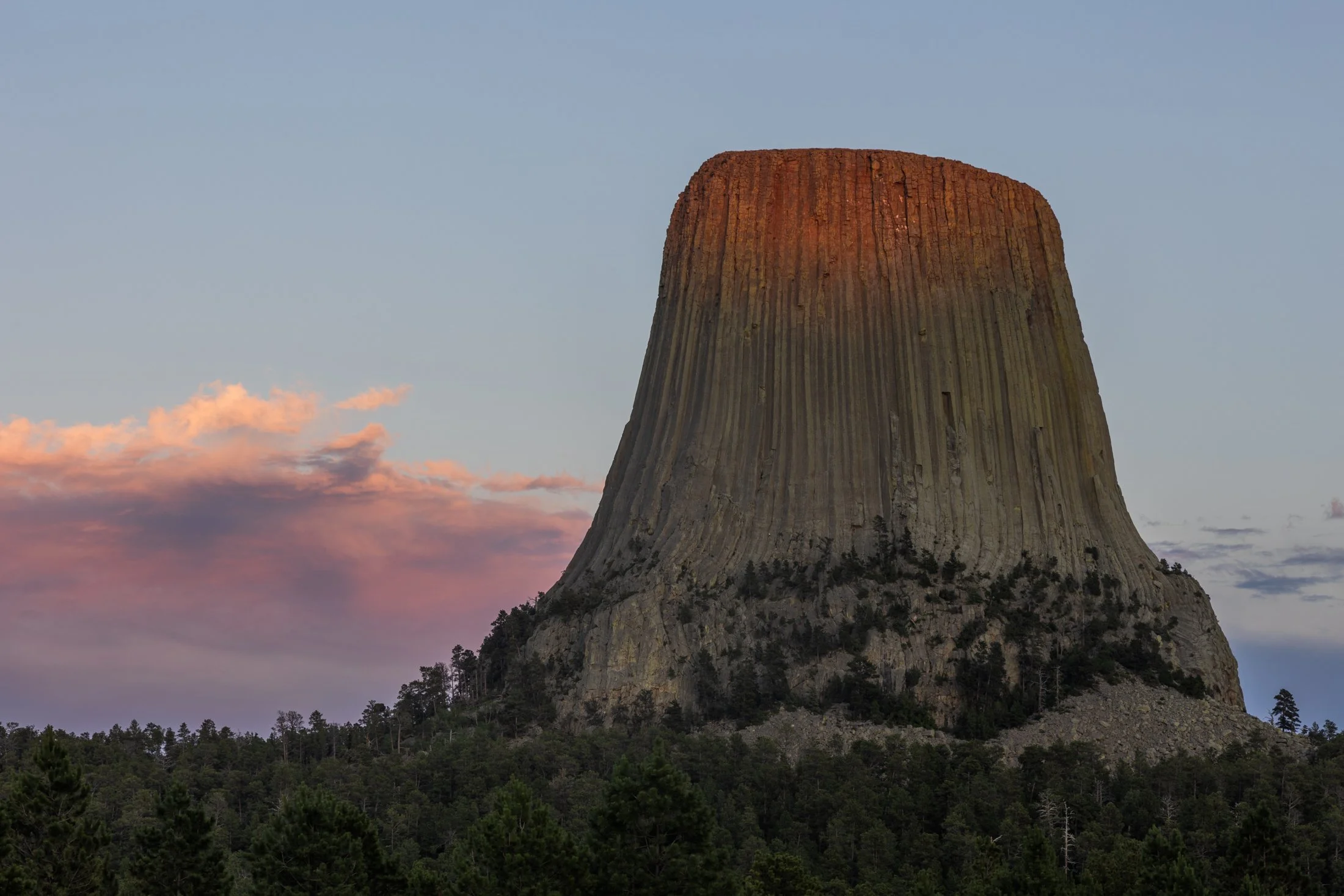
Standing at 867 feet tall, Devil’s Tower, located in eastern Wyoming, has been a sacred site for Native Americans for centuries as well as being featured prominently in “ Close Encounters of the Third Kind” (1977).
The Lakota tribe refers to it as Mato Tipila, roughly translating to “Bear Lodge”. One narrative surrounding its formation involves two girls attempting to escape a large bear by scurrying up a rock formation. The Great Spirit, seeing their plight, rose the rock high into the air to protect them. As the bear attempted to reach them, he clawed the sides of the rock, which formed the basalt columns seen today.
After renting a cabin at the nearby KOA, where “Close Encounters of the Third Kind” is shown every night in front of the monolith, I drove to the southern side at sunset to capture the light slowly fading from the tower. While standing there I could only think one thought; the energy of this land is palpable.

Grand Teton National Park is one of the most stunning mountain ranges in America. The fact that it is located right near Yellowstone makes these two National Parks a one-two knockout.
The Teton Range are prone to strong winds, especially in the spring and fall. These winds often create wispy cirrus clouds accenting the beauty of this staggering mountain range.
I found this scene after showing up to the National Park rather late after a long drive across Wyoming. These peaks are some of the most magnificent America has to offer, and their sheer prominence is a sight to behold.

Early morning in Yellowstone National Park usually comes with thick fog. This fog is caused by the area’s geothermal activity where the warm moisture arising from the hot springs, geysers, and fumaroles meets the cool air of the early morning.
Orb-weaver spiders, known for their iconic wheel-shaped webs, exist in large numbers in the park, making the temperate geysers their home. Their intricate webs are a work of art, and when glistening in the morning dew, like the one pictured here, they reveal their true beauty.
This one appeared as I strolled the boardwalk of the mud pits in the early morning, and I immediately set up my tripod. This exact imagery is referenced in the allegory of Indra’s Net; the buddhist conception of the world.

The Grand Teton mountain range is one of the most breathtaking views in the contiguous United States. The main faulting that formed the range occurred around 10 million years ago during the Miocene epoch.
Since then, the range has continued to rise while the Jackson Hole basin has subsided, deepening the valley. This valley has become an idyllic vacation spot for many tourists during the summer months.
The road leading from the east to Grand Teton National Park is a one of the most spectacular ways to be introduced to the Tetons, and this one point perspective on US Route 26 provided the perfect example.

Artist’s Point is one of the most spectacular places to view the Grand Canyon of the Yellowstone. Located on the south rim, it offers one of the most iconic views in the entire park — a dramatic panorama of the Lower Yellowstone Falls framed by the colorful, rugged canyon walls.
It was thought, although it may be another location nearby, to be the location where artist Thomas Moran sketched his famous images during the 1871 Hayden Expedition, which helped lead to Yellowstone’s designation as the first National Park.
This photograph required an early wakeup call while the roads were still covered in a thick grey fog. When we arrived it was finally beginning to burn off, and the yellows of the morning sun coated this beautiful jagged canyon in light.

A sunset over the Tetons is one of the most stunning views nature has to offer. One reason the Teton Range is famous is due to the dramatic prominence visible from the eastern side, which rises sharply from 4,000 to 7,000 feet above the valley floor.
Aerial debris will often obscure the Tetons during sunset leading to a fascinating ghostly form on the landscape, but when the air is clear the sunsets are incredible, accentuating the fascinating form of one of America’s greatest mountain range.
The mosquitos were in full force as I rushed to set up my tripod shortly after arriving at Grand Teton. I rented a rustic cabin (offered at the Grand Teton campsite), consisting of two unfinished cots and a fire pit. I drove down to the lake and set up this shot while providing a perfect meal for the skeeters.

Hidden Falls of Grand Teton National Park is one of the first things you may miss after jumping on Inspiration Point Trailhead after a ferry ride across Jenny Lake as the trail is not one that stands out.
This area is immensely popular in the summer as the Jenny Lake Trail intersects with it leading to Inspiration Point. This lookout point looks out over Jenny Lake and the surrounding distances that seem to continue on forever.
This waterfall was in full force due to the snowmelt from the winter and to get this particular vantage point involved a bit of scrambling. In the back corner you can see the Teton range extending further into the park.

Standing at 867 feet tall, Devil’s Tower, located in eastern Wyoming, has been a sacred site for Native Americans for centuries as well as being featured prominently in “ Close Encounters of the Third Kind” (1977).
One narrative surrounding its formation involves two girls attempting to escape a large bear by scurrying up a rock formation. The Great Spirit, seeing their plight, rose the rock high into the air to protect the. The distinctive basalt columns were formed from the claws of this bear’s attempt to reach them.
After renting a cabin at the nearby KOA, where “Close Encounters of the Third Kind” is shown every night in front of the monolith, I drove to the southern side at sunset to capture the light slowly fading from the tower. While standing there I could only think one thought; the energy of this land is palpable.

Early morning in Yellowstone National Park, located in northwest Wyoming, often comes with thick fog.
This fog is caused by the area’s geothermal activity where the warm moisture arising from the hot springs, geysers, and fumaroles meets the cool air of the early morning.
While heading to Artist’s Point early in the morning, I noticed the weird quality of light occurring and stopped off at a turnout to capture this eerie orange coloring.

The bison of Yellowstone National Park, in northwestern Wyoming, live in majestic matriarchal family herds. These herds are led by experienced older cows and provide protection, social structure, and learning opportunities for younger bison while the bulls often live alone or in bachelor groups, joining the family herds during the summer mating season.
Yellowstone is home to the largest free-ranging bison population in the U.S., offering a rare glimpse into their natural behavior in the wild. Wild bison in the US once ran into the millions but were almost hunted to extinction in the 1800s. Yellowstone now serves as a sanctuary for these creatures.
When visiting Yellowstone, it becomes readily apparent we are visitors in their home. Traffic is frequently stopped to allow these bison to pass on the road. This shot came from one such instance as the bison herd migrated to the other side of the road.

Hiking the Cascade Canyon Trial in Grand Teton National Park is nothing short of epic. The sheer size of these mountains makes one feel very, very small. The trail runs along Cascade Creek where one can see various wildlife such as moose, bear, and deer.
Snowmelt in the spring and early summer provides vital water for rivers and streams in the Jackson Hole valley and surrounding areas. The Snake River, which runs through the region, is largely fed by snowmelt from the Grand Teton and surrounding mountains.
This shot was an attempt to show the sheer scale of Tetons as I had tried to show a moose against the backdrop and it was a mere speck in the foreground and yet this still does not do justice to the scale of these mountains.
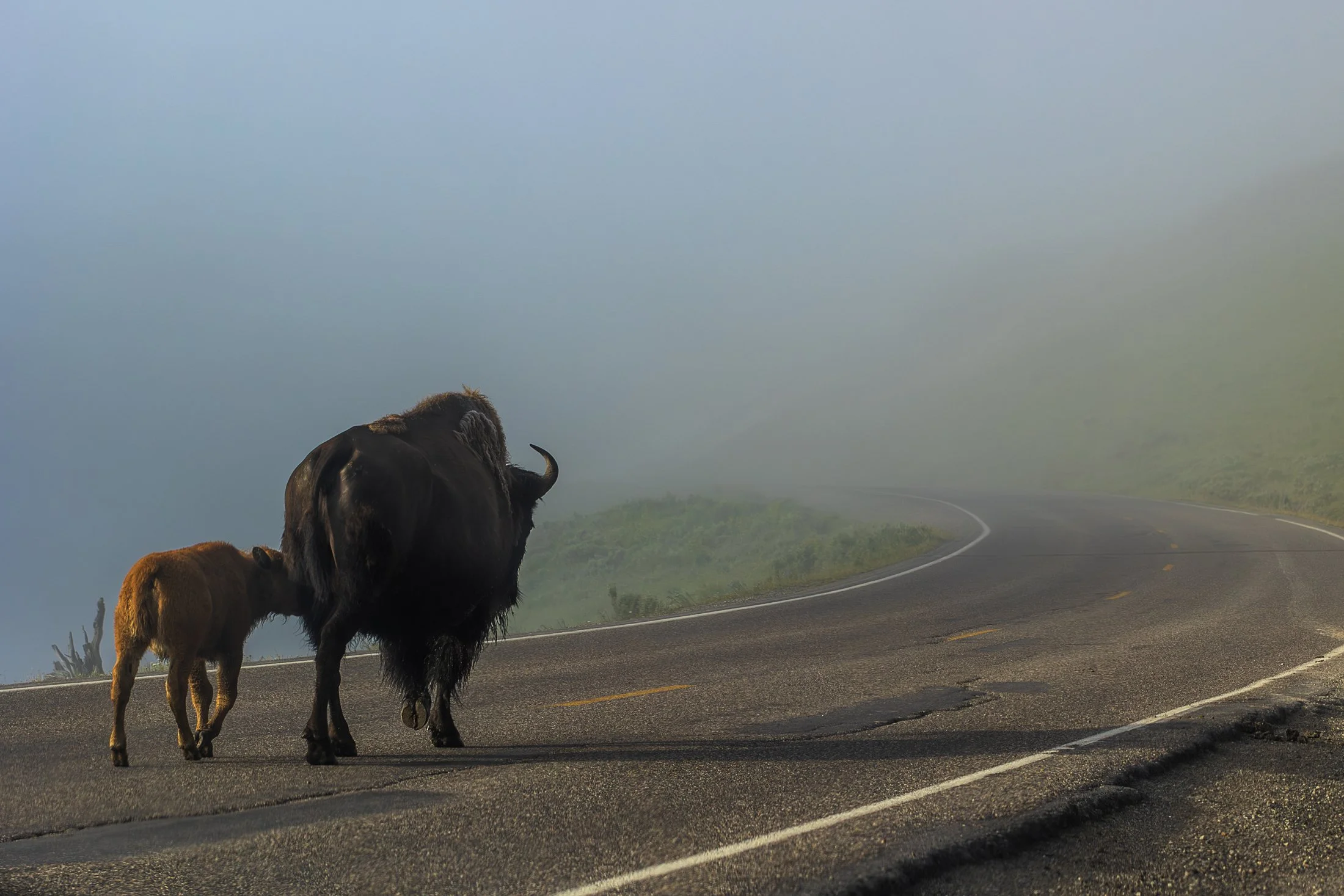
Yellowstone is home to the largest free-ranging bison population in the U.S., offering a rare glimpse into their natural behavior in the wild. Wild bison in the US once ran into the millions but were almost hunted to extinction in the 1800s. Yellowstone now serves as a sanctuary for these creatures.
They live in majestic matriarchal family herds where the experienced older cows provide protection, social structure, and learning opportunities for younger bison while the bulls often live alone or in bachelor groups, joining the family herds during the summer mating season.
When visiting Yellowstone, it becomes readily apparent we are visitors in their home. Traffic is frequently stopped to allow these bison to pass on the road. This shot came from one such instance as the bison herd migrated to the other side of the road.

Mammoth Hot Springs in Yellowstone National Park is one of the most famous sites in the park. It was the site of the first administrative headquarters of the park as well as being home to Fort Yellowstone, a U.S. Army post established in 1886.
The area is known for the travertine terraces pictured here, formed from rainwater and snowmelt seeping into the underlying magma chamber which heats and dissolves the limestone bringing calcium carbonate to the surface.
The springs form fascinating features, seeming to pour out in every direction. These stair steps, as well as the entire land encompassing Yellowstone, teem with life. This is a perfect exit or entrance to the park depending on which direction you are coming from..

Artist’s Point is one of the most spectacular places to view the Grand Canyon of the Yellowstone. Located on the south rim, it offers one of the most iconic views in the entire park — a dramatic panorama of the Lower Yellowstone Falls framed by the colorful, rugged canyon walls.
It was originally thought, though it may be another nearby location, to be the location where artist Thomas Moran sketched his famous images during the 1871 Hayden Expedition, which helped lead to Yellowstone’s designation as the first National Park.
This photograph required an early wakeup call while the roads were still covered in a thick grey fog. When we arrived it was finally beginning to burn off, and the yellows of the morning sun coated this beautiful jagged canyon in light.
Grand Prismatic in Yellowstone National Park is one of the most popular tourist attractions in the park.
Part of the Midway Geyser Basic, this area is fueled by the Yellowstone Caldera, one of the largest volcanic systems in the world.
This turquoise pool is an offshoot of the bigger Grand Prismatic, showcasing the wide open spaces Yellowstone is known for.