

Violets

Violets
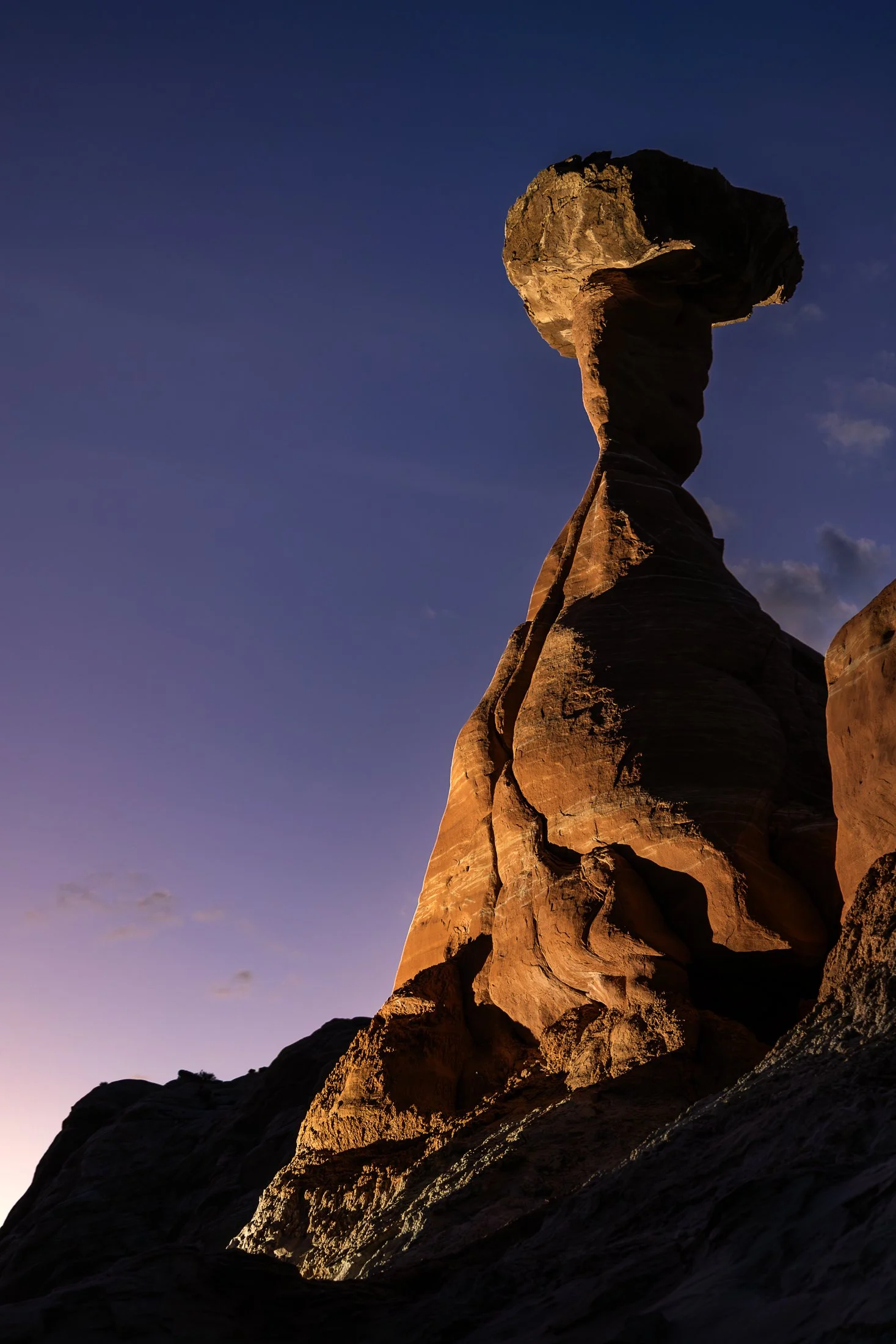
The Toadstool Hoodoos, located outside of Kanab, Utah and Page, Arizona, are part of the greater Grand Staircase-Escalante National Monument. The trail is unassuming, located at a small turnoff on Highway 89. The trail to the hoodoos meanders through the valleys of small eroded plateaus with large amounts of scree covering the area.
These unique formations find their creation from the Dakota Sandstone boulders that sit atop the Entrada Sandstone pedestals. Once the softer Entrada Sandstone erodes, the Dakota Sandstone resides leaving a cap, like a mushroom, on top.
This photo was taken after a group of friends and I decided to stop off here for sunset following a particularly exhausting 8 mile hike through Buckskin Gulch. With the setting sun providing enough darkness for me to use my off camera flash, I channeled my inner studio photographer and directed my friend where to hold the flash to best reveal its form, giving rise to magnificent colors and striations against the purple hue of the setting sun.
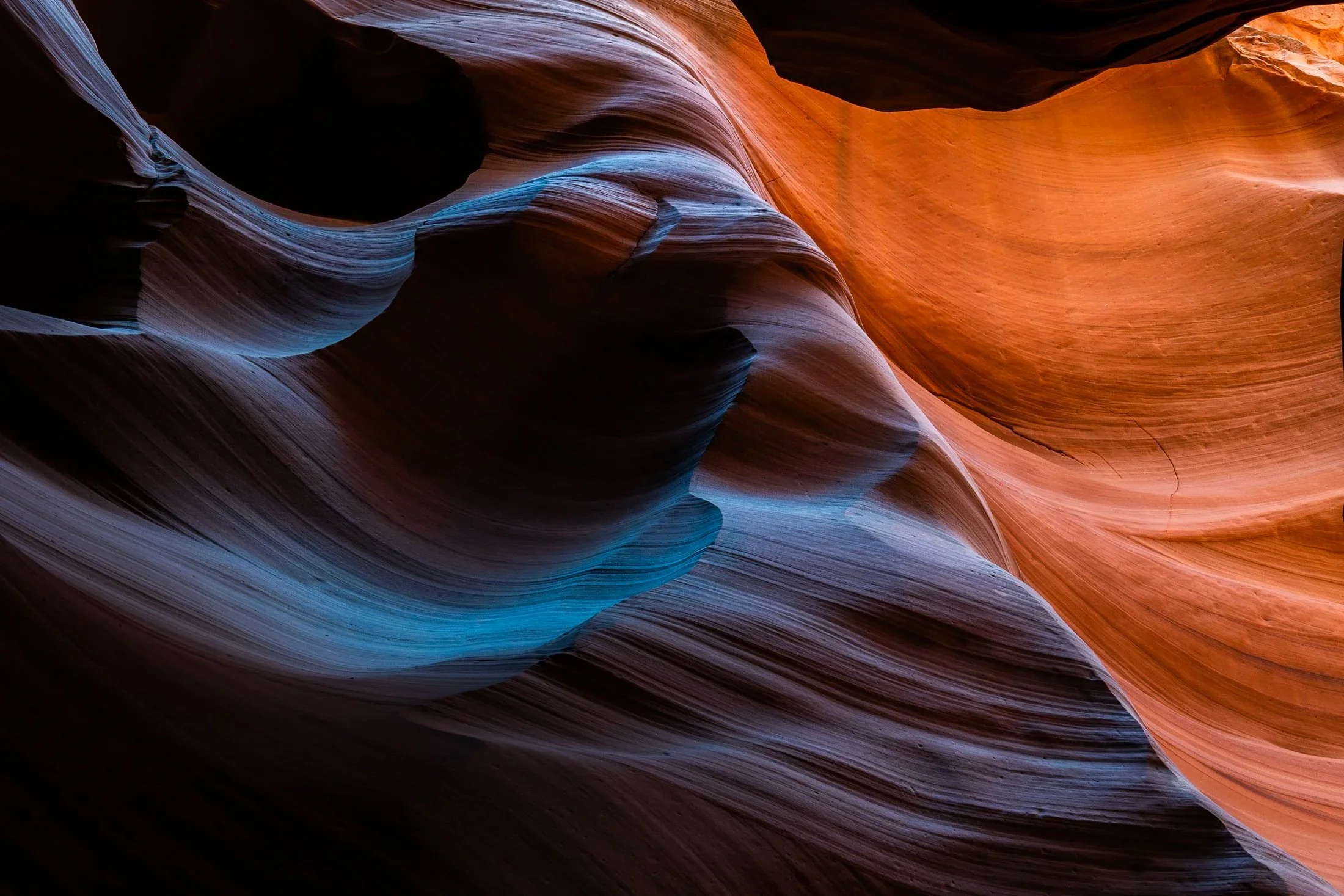
Antelope Canyon, located in northern Arizona within the Navajo Nation right outside the town of Page, is one of the most picturesque slot canyons in the world. Running over 23 miles, it was formed over millennia through consistent erosion, primarily through the actions of flash floods that sculpt the sandstone rock into smooth, undulating forms.
Having traveled to Page numerous times, I had always opted for Buckskin Gulch, another slot canyon in the area that resides on BLM land and does not require a paid tour. My fourth time in the area I decided to partake on a tour and the views did not disappoint. Guided by a local Diné (Navajo) tour guide, I was entreated to various stories of Navajo belief as well as given a private photography tour of the canyons.
The canyons continually conceal and reveal form throughout the day, as the sun follows its path across the sky. My tour followed a relatively short section of the greater Antelope Canyon, and yet I found I could have spent days here and never arrive at the same photo twice. This abstract section reinforces the stunning tonality and color nature creates in the shade of these canyons.

The Garfield Park Conservatory in Chicago, Illinois contains different flora from all around the world, and is located right off the Green Line on the El system making it easy access for many in Chicago through public transportation.
Cactus flowers primarily bloom in spring or early summer and in many cultures are a symbol of strength, endurance, and persistence. They characteristically have thick petals and stamens to protect the reproductive parts from harsh desert winds or sand.
I brought a small tripod and LED light to the conservatory to capture a range of different plants with more color and drama than ambient light typically allows and this little cactus flower captured the light just right.

Mount Hood is an iconic stratovolcano located just outside Portland, Oregon in the Cascade Range. Standing at 11,240 feet, it is the highest peak in Oregon and one of the most recognizable mountains in the Pacific Northwest.
Visible from miles around, the mountain is often in full view from Portland, Oregon, located about 50 miles to the west, and offers up near perfect symmetry and a towering presence.
Only visiting for a day and having the Japanese Gardens planned for the next morning, I had not planned to photograph this day as a stop in Portland requires me to make the rounds at Powell Books, Blue Moon Camera, and Music Millennium, but I after I got back, I decided to walk up the street from my Airbnb at sunset and found myself in the perfect location to capture this magnificent mountain.

Originally covered by oceans and rivers, Monument Valley is a testament to time. Located on the Colorado Plateau near the Arizona-Utah Border, the valley displays the wondrous effects of weathering and erosion.
With the softer rock being eaten away over time by the elements, the harder rock is left exposed in curious and awe-inspiring formations that have religious significance for the Diné (Navajo) People and iconic significance for the American West.
Pictured here is “Sentinel Rock” profiled with an edge light from the setting sun. I was able to capture this photo right from my campsite, one of the most beautiful I’ve ever camped at, which also sits facing The Mittens.
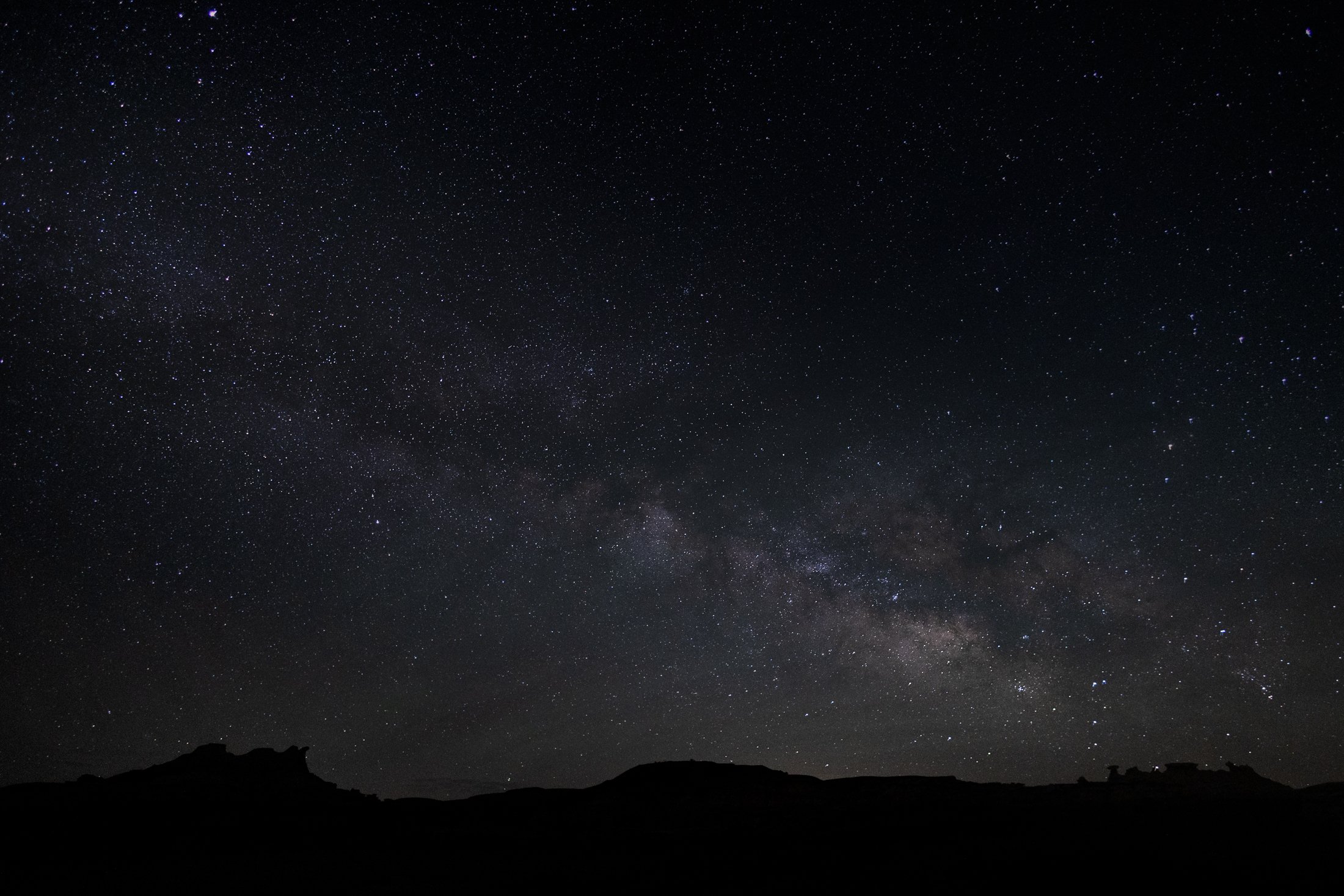
The Bisti Badlands are a remote and alien world in northwest New Mexico situated in the Bisti/De-Na-Zin Wilderness, an area protected by the Bureau of Land Management.
The name comes from the Dinë (Navajo) word “Bistahi” translating roughly to “among the adobe formations”. The wind-formed hoodoos in this region are numerous leading to bizarre formations, varied colors, and precariously balanced rocks. The area doubles as a designated dark sky territory providing an unpolluted night sky.
This was my second time visiting this desolate world, and this time I backpacked in at sunset and spent the entire night photographing around camp, using my headlamp to paint the rocks. Finally, late into the night, the Milky Way became visible with the naked eye, and this silhouette of the landscape perfectly framed our beautiful galaxy. It was a stunning sight.

Haystack Rock near Pacific City, also known as Chief Kiwanda Rock, is an enormous sea stack located just offshore from Cape Kiwanda in Pacific City, Oregon.
Standing approximately 327 feet, it is one of the tallest sea stacks on the Oregon coast, even taller than the more famous Haystack Rock in Cannon Beach.
This was taken during a bustling evening near the Pelican Brewing Company, where patrons dined as the light broke through at golden hour, giving way to these stunning clouds behind the sea stack, casting its true form in silhouette. And if you look closely you’ll see the staggering amount of birds which call it home.

Buckskin Gulch, located in the Paria Canyon-Vermilion Cliffs Wilderness area, is the longest and deepest slot canyon in United States and possibly the world.
Marked by their sinuous carved rock, typically sandstone, slot canyons are often formed through water erosion over long periods of time. Flash floods are what make these strikingly beautiful canyons also some of the most dangerous to hike, with the runoff from a storm ten miles away potentially leading to the canyon on a day with clear skies.
These walls form their own abstract art where light reveals and conceals form, changing each minute with the path of the sun. This patch in particular caught my eye, not only for its abstract nature, but the small patch of life growing along its walls.
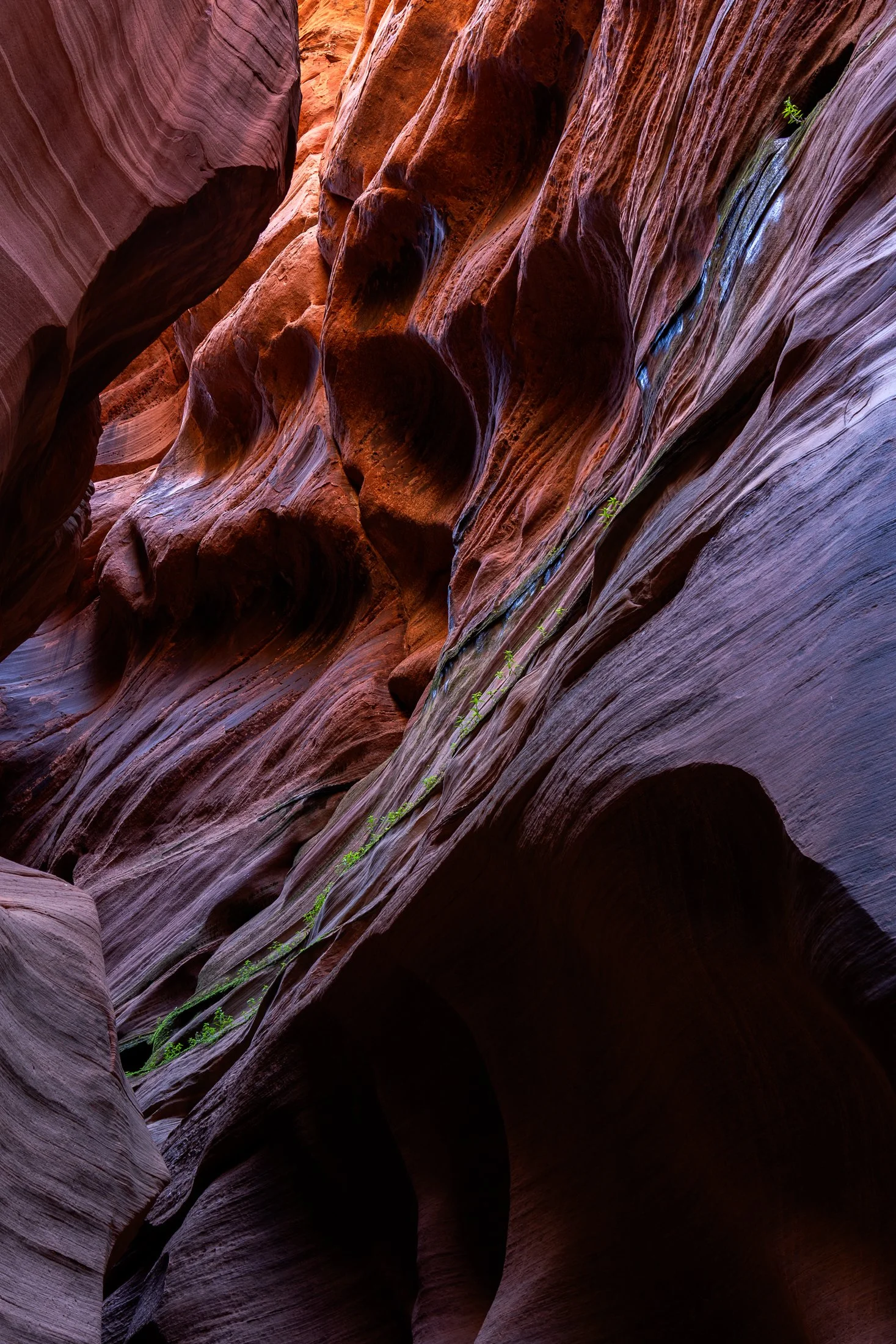
Buckskin Gulch, located in the Paria Canyon-Vermilion Cliffs Wilderness area, is the longest and deepest slot canyon in United States and possibly the world.
Marked by their sinuous carved rock, typically sandstone, slot canyons are often formed through water erosion over long periods of time, often coming from flash floods. This is what make hiking these beautiful canyons so dangerous. A storm from ten miles away can funnel into the canyon on a day with clear blue skies.
The plant growth on the side of this canyon is a unique sight. Small amounts of water and sunlight find their way to these plants allowing them to survive in this surreal environment.
The area around Starved Rock State Park near Utica, Illinois, is one of the most scenic Illinois has to offer. The Illinois River cuts through the area and was one of the few areas in Illinois not flattened by glacial drift.
This beautiful tree on the bank of the Illinois river is a Sycamore, known as the London Plane. Often planted in the Victorian area to help quell the London pollution caused by the Industrial Revolution, this tree has been a stable of urban development. It can incur a disease known as the Witches Broom, causing the shoots to bunch up which also offers a natural nest for nearby birds.
Camping on the edge of the Illinois after a trip to Starved Rock, I set up my tripod to capture the active birds at sunset, but then this Sycamore caught my eye. The composition of the eerie branches against the beautiful purple glow of the setting sun was mad even better by the birds passing through the area.